Popular Highlights
When only a watchmaker will do
Restoration of Omega Jump Seconds Clock
| Rogue's Gallery |
 |
|||
Here are some examples of repairs that actually decrease the value or historical importance of a timepiece. Some of these were done by those who simply did not know any better, others by people trying to "get the thing to tick" so that they could sell the timepiece. The fascinating examples are those repairs that were made by people who obviously possessed innate talent and mechanical gifts. These are the ones that show considerable effort; but were misguided in that the proper approach would have required less effort. While such efforts cause me to shake my head in wonder, most collectors do not appreciate these modifications to the original workmanship and character of the piece. Perhaps the most annoying "botches" involve chronometer detents. The motivation is simple, to make a damaged expensive instrument tick for next to nothing. Never mind that it is no longer a chronometer, that its rate stability has been destroyed. It ticks and can be sold to an unsuspecting buyer for full retail. Chronometer escapement detents cannot be "repaired". There simply is no alternative but to make a replacement detent. I consider this annoying because it almost always involves an unsuspecting novice collector who finds out about the fraud only when they the instrument in for service. Here is a sample of "repaired" detents I have removed from chronometers.
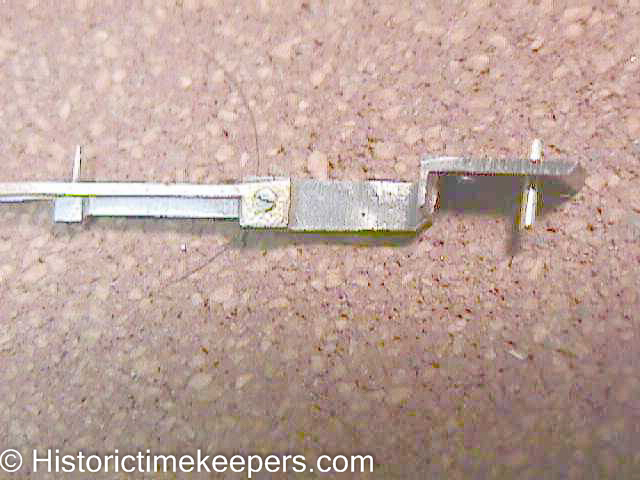
The detent below is the kind of "repair" I see a lot. Having broken the spring off at the foot, the would be repairman slit the foot and "let in" a spring and arm he filed up. Sometimes it is the original spring used (albeit shorter). In this example, the new part was not even hardened and tempered, so there is absolutely no "spring". At any rate, the spring is always soldered in and its properties destroyed by the heat.
|
||||
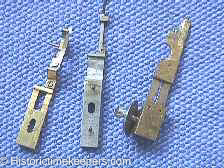 Two
of these recently came out of Hamilton M21 chronometers. compare
these to the Replacement Detents.
Two
of these recently came out of Hamilton M21 chronometers. compare
these to the Replacement Detents.